I give Meira a goal, and Meira keeps a whole team of AI agents on it until it is done or really needs me.
Active development
Meira is my AI orchestrator: a local desktop app and command line tool that breaks a goal into orders, sends them to parallel coding agents in their own Git worktrees, checks every result against tests and an independent review, and only then merges it. A Claude session acts as the orchestrator, Codex lanes write most of the code, and Meira holds everything that would otherwise get lost between sessions: the goal, decisions, jobs, quota and who is allowed to do what.
Status 22 Nov 2026: in daily use on my own projects, private repository, Windows first. The first real-goal test, a 7 Days to Die mod built from an empty repository, passed.
Meira started in June 2026 as a small session dashboard inside the P.R.I.S.M. repository, because I had several Claude and Codex sessions running in parallel and kept losing track of who was touching which file. It grew from there: first claims and handoffs, then jobs and worktrees, then verification, and at the end of September it moved into its own repository.
Back then I wrote its goal down in my own words: an orchestrator that pursues a goal, takes the busywork and the small decisions off the agents, keeps the repository safe and prevents hallucinations without any agent holding half the repo in its context. Honestly, that was a bigger goal than I realised at the time, and it is exactly the kind of problem that got me hooked.
02 / Today
What Meira does today
Hold the goal
The goal, the plan, every decision and the full job history with its evidence live in one local database, so a fresh orchestrator session picks up exactly where the last one stopped. A handover tool starts the successor session by itself.
Turn work into orders
An order tool writes each job with its goal, owned paths, acceptance tests and model route. A lint step catches overlaps before anything is dispatched, and every lane gets its own branch, worktree and file claims.
Run agents in parallel
Meira starts the agents headless, watches them, continues a rate-limited lane after the reset, and runs up to 20 Codex lanes at the same time. Each one stays on its own branch and inside its owned paths.
Trust nothing, verify everything
A lane report counts as reported, not as verified: Meira checks it against Git, re-runs the acceptance tests itself, and a different session reviews the work independently. merge-lane then tests the merged tree in a temporary worktree under the project's test policy and only then moves master. A red merge gets compared with a clean baseline before anyone takes the blame.
Spend quota wisely
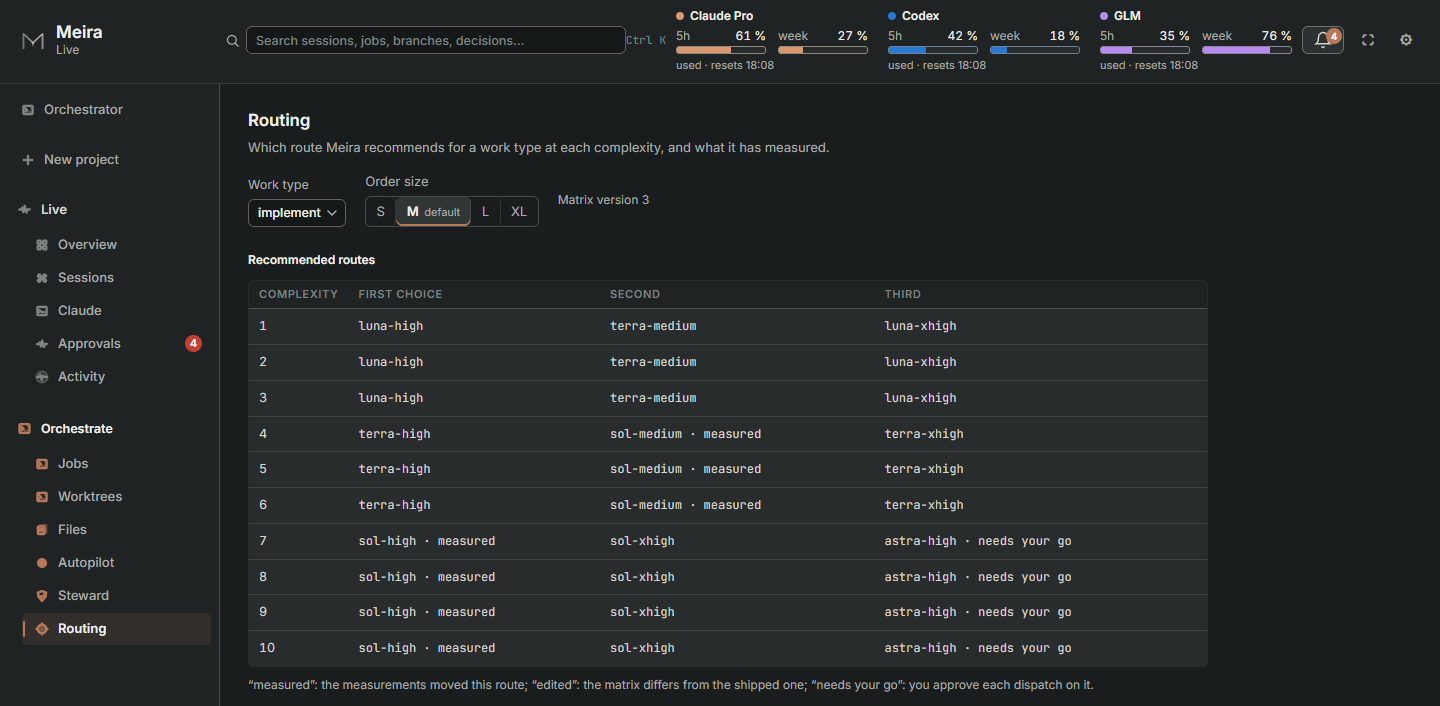
Meira reads the 5-hour and weekly windows of the coding plans, measures which model passes first time for which kind of work, and recommends a route per order. Subscription plans only, never metered API billing. If quota is unknown, Meira says so instead of treating it as free.
Keep the human in charge
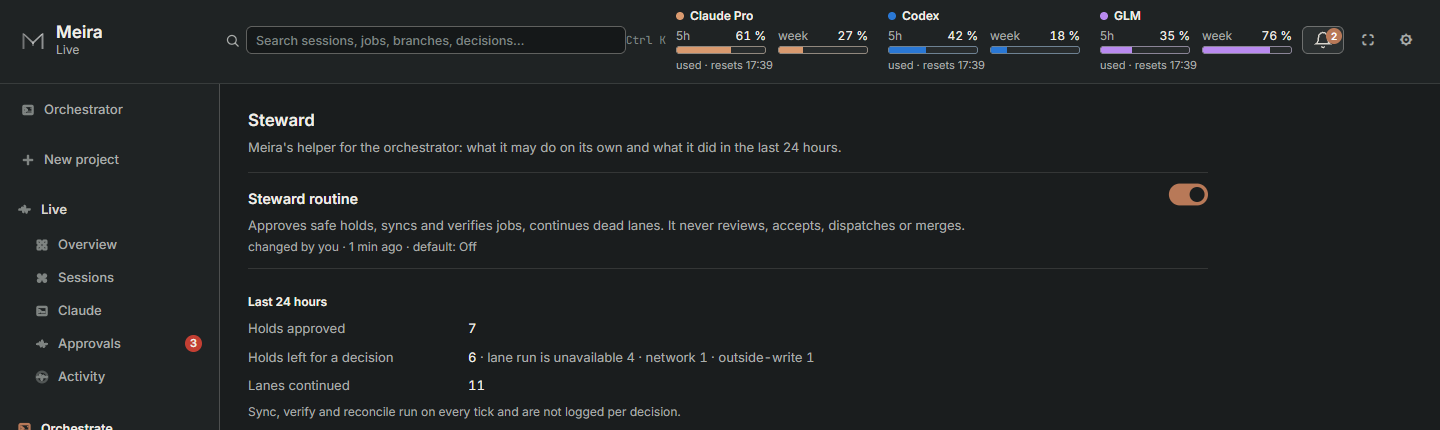
A gate decides on every tool call of a lane: allow, deny or hold, and every decision lands in an audit trail. A steward approves the safe holds and continues stuck lanes, but it never reviews, merges or dispatches on its own. New specs and priorities stay with me.
Start new projects
A wizard sets up a new repository, today for game-modding projects, with reviewed templates, skills, rules and a project profile, takes a goal plus done criteria and opens a planning session. From there, one button hands over to the orchestrator.
Leave me alone
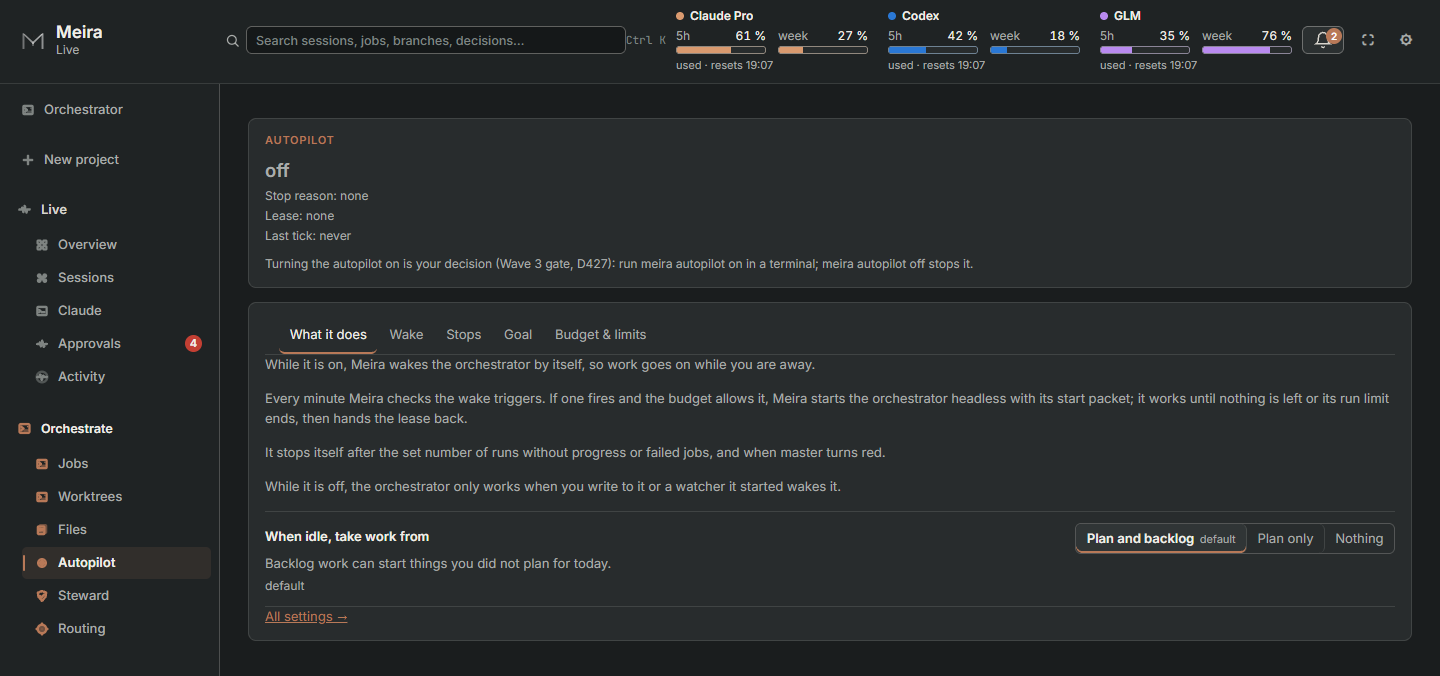
With the autopilot on, Meira wakes the orchestrator by itself as soon as a batch reports. A Windows toast or a push to my phone only shows up when something really needs me.
03 / Architecture
How Meira is built
A high-level overview. Every order takes the same path, whichever agent works on it:
01OrderWritten by the order tool, linted, then dispatched
02LaneAn agent on its own branch and worktree
03ReportWork commits, then a separate report commit
04VerifyChecked against Git, acceptance re-run
05ReviewA different session reads the evidence
06merge-laneMerged tree tested, then master
If verification or review finds a problem, the job goes back to a lane as a fix round. A pushed report on its own never counts as done.
Underneath, it is a handful of parts around one single database:
One local home
One SQLite database outside every working copy, with migrations, automatic backups and WAL mode. It records goals, jobs, holds, usage and evidence; code, reports and logs stay in Git and files. Worktrees are only sandboxes and never get a database of their own.
A Python core
About 215 modules. The command line, with well over a hundred commands, and the local FastAPI server share the same orchestration service, so a click and a command go through the same checks.
The console
A local web interface in plain JavaScript with no build step and live updates over WebSocket, in a native desktop window or in the browser. Live shows what needs me, sessions, approvals and activity; Orchestrate shows jobs, worktrees, file claims, steward, routing and autopilot.
Provider bridges
Codex lanes run headless over the Codex App Server protocol, Claude Code carries the orchestrator, and GLM is another lane option where it is switched on. An adapter for Claude worker lanes exists, but it is not used for lanes right now.
Routing and quota
A model catalog and measured results rank model and effort routes per order, and the lane launch pins the chosen one. Quota readings and reset times are normalized; when a plan runs dry, a continuation policy decides whether to back off, wait or escalate.
Gate and holds
Works out who is calling, classifies the command and answers allow, deny or hold. Holds go to me or an authorized delegate, and authority is checked again at the moment of the decision. A local model may advise on failure triage but never approves anything, and a worker cannot gain authority by writing it into its report.
Steward
A routine on the server tick: approve eligible holds, sync reports, run one verification at a time, continue permitted lanes and reconcile. Judgment stays with the orchestrator; the steward never dispatches, reviews or merges.
Autopilot tick
A separate short tick, every minute while it is on: poll the lanes, sync and verify reports, watch integrations, apply the wake and stop rules, wake the orchestrator and send notifications. Opening the console never switches it on.
Settings and profiles
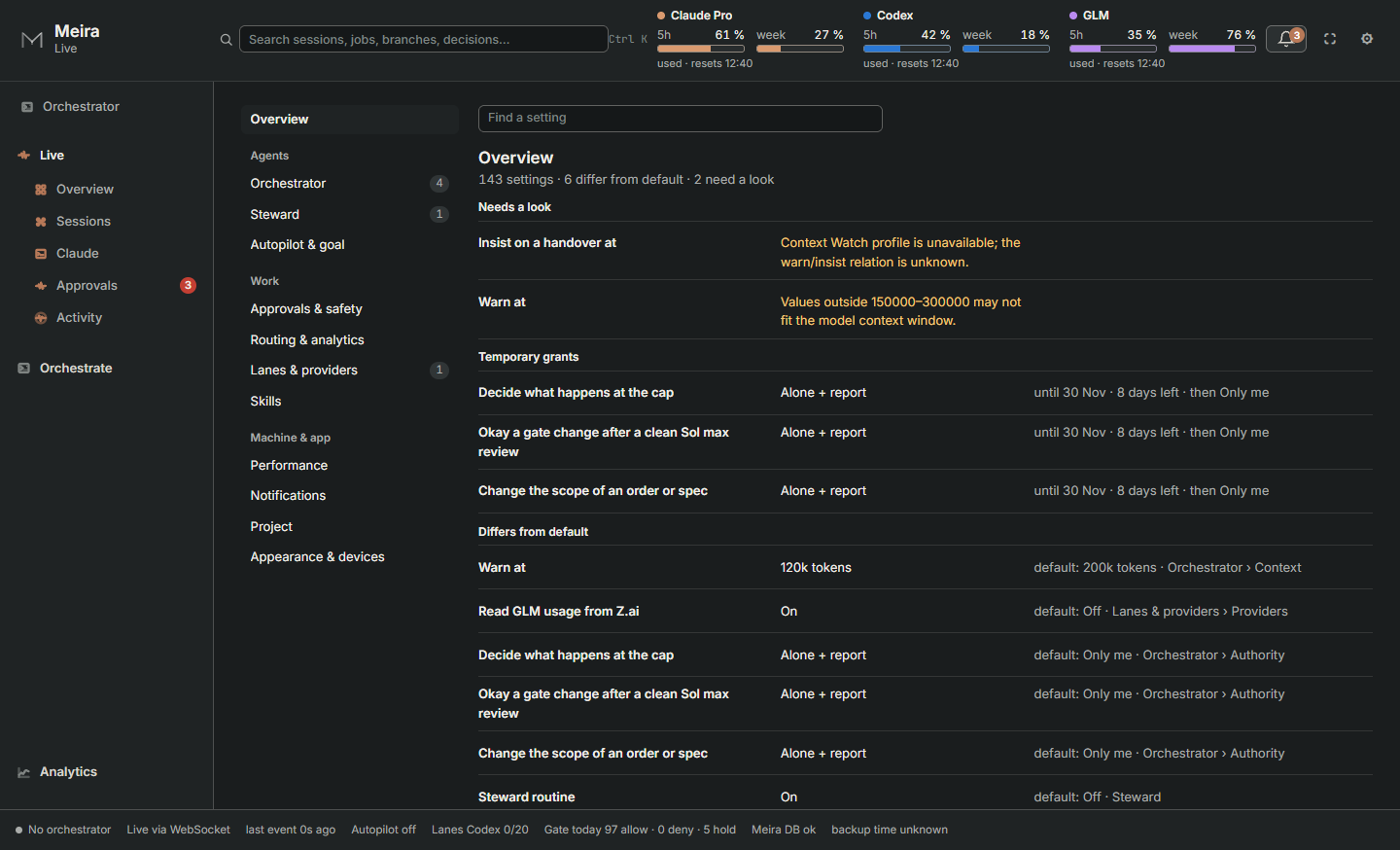
One registry declares every setting with its type, default, scope, who may edit it and when a change takes effect. Command line and console share the same validation, audited writes, risk confirmation and Undo. On top, every project has a profile with its allowed remotes, programs and safety level.
04 / Product views
Meira in action
Real views from the current build, captured on 22 Nov 2026 on a development instance with sample data. The only edit was a crop to remove a local path.
The autopilot, explained in plain wordsWhat the autopilot does sits right next to its state. Turning it on stays my decision.What the steward may do aloneThe switch and the last 24 hours: which holds the steward approved by itself and which it left for a decision.Which model for which workRecommended routes per complexity, marked where measurements moved a route. The values in this capture are sample data.Every setting in one place143 settings with search and undo; temporary grants expire on a date and then fall back to "only me".
05 / Demo
Demo: a mod from an empty repository
When I show Meira to someone, I start with a short tour of the console and send one tiny order in a throwaway project down exactly the path above, from order to merge. That way you see the difference between reported and verified with your own eyes. I rehearse that run beforehand, and a replay is always called a replay.
Then comes the real thing: the real-goal test from 15 to 17 Nov 2026. The one metric was how often I had to step in.
01
The goal
I described a new 7 Days to Die mod for the Asylum modpack in a few paragraphs: random events like a pack of bears spotting you in the pine forest, trigger events when you kill too many zombies or stay too loud for too long, and bandits with raids on your base, just without rocket launchers, because losing the whole base to one grenade would be plain mean. Claude turned it into a spec and asked me four questions.
02
A fresh repository
Meira got a new private repository with a solo profile, and for this one run the autopilot had my explicit go.
03
Research first
A Codex lane looked into the game version, the bandit configuration, gear, affix tokens and hooks before a single line of code was written.
04
Three phases, many lanes
Random events, trigger events, bandits and raids: each phase split into orders, built by Codex lanes in their own worktrees, verified, reviewed and merged through the project's own build and tests.
05
On a real server
With my go, the orchestrator built the mod, uploaded it to my dedicated game server and updated my client, with checked hashes. Starting the server and playing stayed with me.
06
My part
Three interventions in total: a version question, a watcher that did not wake up, and one allowlist entry. Each one went into Meira's backlog as something to fix. On top came my planned test sessions in the game. On 21 Nov I accepted all three phases as successful; no fundamental code problems showed up, only the balancing is still open, and that is gameplay feedback, not a code defect.
06 / Numbers
In numbers, with dates
5,166commits
Meira repository, 28 Sep to 22 Nov 2026. The history before that lives in the P.R.I.S.M. repository.
about 13,600automated tests
12,812 Python and 801 JavaScript tests green on 22 Nov 2026.
586numbered decisions
Append-only decision log, my decisions quoted word for word, as of 22 Nov 2026.
3interventions by me
Real-goal test asylum-events, 15 to 17 Nov 2026, three phases from research to the server.
07 / Roles
Who does what
Me
The goal, priorities and every spec, product and UX decisions, shaping the interface in design sessions, acceptance in the GUI and the tests in the game. I did not write Meira's code by hand.
The agents
Claude orchestrates: it writes orders, reviews and integrates. Codex lanes write code, tests and documentation and deliver independent reviews. Their reports only count after the check.